
An original Dream Green game. Over 100 thousand now sold worldwide but unfortunately it is now made illegally by others in China, India and other countries.
Master the basic elements of chess within 5 minutes, including moves and strategy without being intimidated. This quick, fun game combines aspects of both chess and tic tac toe. The object of the game is to get your four pieces, a Knight, a Rook, a Bishop and a Pawn in a line before your opponent does.

"Chess is an easy-to-learn game which provides educational benefits to K-12 students. Recently I learned about Tic Tac Chec, a chess variant which (like chess) promotes problem solving among its players. My son and I played several Tic Tac Chec games and together figured out a few strategies for our next playing session--Dr. Alexey Root, author of " Children and Chess: A Guide for Educators."
"One of our most popular teacher items. Tic Tac Chec teaches chess unlike any other product we've seen! A must have for any classroom!" Jeanne Voigt - Owner, Mindware catalog
"Simple chess! This beautifully crafted wooden board game combines Tic Tac Toe with chess to provide kids with an easy and fun way to learn chess strategies. Children enjoyed this two-player hybrid version and it proved quite helpful in mastering moves. Players found it quick to set up, quick to learn and quick to play. A great introduction to the classic game. Rating ***" Canadian Toy Testing Council
GAMES Magazine awarded TIC TAC CHEC their prestigious "GAMES 100" Award, calling the game easy to play but also "... a tricky little game even for chess masters". TIC TAC CHEC has been called "the perfect introduction to chess" by Dr. Toy and awarded a DR. TOY Top 10 Game Award. TIC TAC CHEC has been called the perfect travel game and awarded an EDUSOURCE Top 10 Game Award. TIC TAC CHEC has been awarded Three Stars (their highest award) by the Canadian Toy Testing Council. TIC TAC CHEC was selected for the 2002 Parenting for High Potential Holiday Toy List and the 2003 Today's Parent Holiday Toy List.
Master the basic elements of chess within 5 minutes, including moves and strategy without being intimidated. This quick, fun game combines aspects of both chess and tic tac toe. The object of the game is to get your four pieces, a Knight, a Rook, a Bishop and a Pawn in a line before your opponent does. Captured pieces are returned and can be played again. Both novice and avid chess players will love this game which is both exciting and challenging. Silk screened on hard wood with wood playing pieces. Complete instructions included. - Instructions in English, French, Spanish, German, Italian, Arabic, Dutch, Chinese & Japanese.
Piece move diagram and instructions for Tic Tac Chec (pdf), the game instructions are on the back of the box.
Ⓒ1995 Donald Green with United States Copyright Office - Library of Congress USA # TX 4-327-443
Translated the 15 Feb. 2008 by the wonderful Ursula Etzlinger and her son of Austria. Many thanks - Don
The fastest, easiest way to learn Chess and the most fun and popular chess variant in the world. A gift for life.
DEUTSCH: Der schnellste und einfachste Weg, um jene Variante von Schach zu lernen, die am meisten Spaß macht und zudem noch die weltweit bekannteste ist! Lernen Sie die Grundlagen des Schachspielens in wenigen
Minuten mit dieser Kombination aus Schach und Kreuzchen & Kringelspiel. Für Anfänger and alle Schachspieler.
Für zwei Spieler. Alter: ab sechs Jahre. Inhalt: Spielbrett, 2 Türme, 2 Läufer, 2 Springer, 2 Bauern
Four important reasons for learning chess with Tic Tac Chec:
1/ There are only one-fourth as many pieces, so it is less confusing for a beginner.
2/ Captured pieces are returned and can be played again on ANY open square thus preventing new players from getting discouraged.
3/ Games only last a few minutes. There is no time spent setting up the board. Beginners don't use time "trading" pieces until there are only a few left at which time they are able to contemplate a strategy to defend their own King and capture the opponent's.
4/ Immediate recognition of mistakes. On a regular chess board beginners seldom remember where they made strategic errors and thus take longer to learn to avoid repeating them. A basic error while playing Tic Tac Chec almost always leads to instantly losing the game.
Die vier Hauptgründe, warum man Schach mit Tic Tac Chec lernen soll:
1/ Nachdem es nur ein Viertel der Spielfiguren gibt, ist es für den Anfänger nicht so verwirrend.
2/ Geschlagene Figuren kehren auf irgendein offenes Feld im Spiel zurück und vermeiden bei neuen Spielern ein entmutigtes Aufgeben.
3/ Das Spiel dauert nur ein paar Minuten. Das Aufstellen der Spielfiguren ist schnell erledigt. Anfänger verwenden keine Zeit zum Austausch von Figuren bis nur ein paar Figuren übrig sind, wo eine Strategie entwickeln können, um ihren König zu verteidigen und den des Gegners gefangen zu nehmen.
4/ Schnelles Erkennen von Fehlern. Bei regulärem Schach erkennen die Spieler selten die Fehler in ihrer Strategie und machen sie daher immer wieder. Bei Tic Tac Chec führen einfache Fehler fast immer zum sofortigen Verlust des Spieles.
RULES:
REGELN
Be the first to align your four pieces of the same color horizontally, vertically or diagonally.
Gewonnen hat, wer seine vier Figuren gleicher Farbe horizontal, vertikal oder diagonal angeordnet hat.
Play starts on an empty board, players take turns placing a piece on ANY empty square. After placing your first three pieces you may move and capture as in regular chess, except a pawn reverses direction upon reaching the opposite side of the board. Players can capture each other and have less than 3 pieces on the board. Captured pieces are returned to their owner and can immediately be played again on any open square.
Das Spiel beginnt auf einem leeren Brett, indem jeder Spieler je einen Stein auf ein beliebiges freies Feld setzt. Nachdem man seine ersten drei Figuren gesetzt hat, kann man wie beim gewöhnlichen Schach mit ziehen und schlagen. Nur der Bauer kehrt seine Bewegungsrichtung beim Erreichen der gegenüberliegenden Seite des Brettes um. Die Spieler können sich gegenseitig schlagen und weniger als drei Figuren am Spielfeld haben. Die geschlagene Figur geht wieder an ihren Besitzer zurück der diese wieder auf ein beliebiges freies Feld setzen darf.
Optional Rules: Recommended for competitions. Players are allowed approximately 3 minutes to place their first 3 pieces on the board with a maximum of about 30 seconds per turn. After a further 5 minutes of play (this can be adjusted) and an equal number of turns each player is restricted to 5 captures each. Playing this rule will generally make games end in less than 15 minutes and require more skill.
Optionale Regeln (Empfohlen für Wettkämpfe): Die Spieler haben ungefähr drei Minuten Zeit um ihre ersten drei Figuren auf dem Spielfeld zu platzieren, wobei pro Figur maximal 30 Sekunden gebraucht werden darf. Nach weiteren
fünf Minuten des Spiels (diese Zeit kann variiert werden) und einer gleichen Anzahl an Zügen darf jeder Spieler noch fünf Züge ausführen. Das Spielen nach dieser Regel lässt Partien nach weniger als 15 Minuten enden und erfordert mehr Können.
Chess Piece Moves:
Schachzüge nach Figuren:

Pawn: - Moves one space forward per turn except when it captures an opponent's piece by moving one space diagonally forward.
Bauer: - Pro Zug kann er sich ein Feld vorwärts bewegen. Er kann eine andere Figur nur diagonal schlagen.
Knight: - Moves either one space forward or backward and two spaces either left or right or two spaces forward or backward and one space either left or right. A knight is the only piece that can move over another piece on the board.
Springer: - Bewegt sich ein Feld vorwärts oder rückwärts und zwei Felder nach links oder rechts, oder zwei Felder vorwärts oder rückwärts und ein Feld nach links oder rechts.
Bishop: - Moves diagonally any number of spaces as long as it does not pass another piece.
Läufer: - Bewegt sich diagonal beliebig viele Felder, solange er keine andere Figur passiert.
Rook: - Moves vertically or horizontally as long as it does not pass another piece.
Turm: - Bewegt sich vertikal oder horizontal solange er keine andere Figur passiert.
The Knight, Bishop and Rook all capture by landing on an opponents piece in the same way that they move.
Tips:
Tipps:
1/ - Only capture your opponents pieces if it is really necessary to prevent them winning or if it truly helps you get 4 pieces in a row.
1/ - Schlage nur die gegnerischen Figuren wenn es wirklich notwendig ist um sie vom gewinnen abzuhalten oder wenn es dir wirklich hilft, deine vier Figuren in eine Reihe zu bringen.
2/ - Always play to win.
2/ - Spiele immer um zu gewinnen.
3/ - Play a flexible strategy where two or more rows are an option to win. Fixating on a single row will most likely lead to a stalemate at best and more likely a loss.
3/ - Spiele mit einer flexiblen Strategie bei der du zwei oder mehrere Reihen als Option zum gewinnen offen hältst. Fixierst du dich nur auf eine einzige Reihe, wird der Ausgang des Spiels bestenfalls ein Patt sein oder eher dein Verlust.
4/ - Use a felt tip marker to mark one side of the pawn and always play with this mark facing the direction of movement. This will help you remember its direction.
4/ - Markiere mit einem Filzstift eine Seite des Bauern und richte diese immer in Bewegungsrichtung aus. Das wird dir helfen, dir die Bewegungsrichtung zu merken.
5/ - As in regular chess, dominating the center of the board helps as some pieces have more potential places to move to.
5/ - Wie im normalen Schach hilft es, das Zentrum des Spielfeldes zu dominieren, da manche Figuren mehr potentielle Züge ausführen können.
6/ - Avoid trying to make a row of pieces on your first horizontal row of squares.
This will most likely lead to defeat as it is difficult to move the pawn back to this row if it is already on the board.
6/ - Vermeide, die Reihe deiner vier Figuren in der ersten Reihe des Spielfeldes zu machen. Hier wirst du am ehesten verlieren, da es schwierig ist, den Bauern zurück zu dieser Reihe zu bringen wenn er bereits an der Begrenzung ist.
Ⓒ1995 Donald Green with United States Copyright Office - Library of Congress USA # TX 4-327-443
ENGLISH:
The fastest, easiest way to learn Chess and the most popular chess variant in the world. A gift for life.
A winner of multiple awards and accolades.
Millions of people have mastered the basic elements of chess within minutes playing Tic Tac Chec including moves and simple strategy without being intimidated. This quick, fun game combines aspects of both chess and tic tac toe.
For 2 players. Ages 6 and up. Contents: Wood board & pieces, 2 Rooks, 2 Bishops, 2 Knights, 2 Pawns
Français:
Apprendre les échecs rapidement et facilement. La variante la plus populaire du jeu d’échecs dans le monde. Un cadeau pour la vie. Parfaite introduction aux échecs, ce jeu, très apprécié, a gagné de nombreuses récompenses.
Avec Tic Tac Chec, des millions de gens ont maîtrisé les éléments de base des échecs : Mouvement des pièces et stratégie. On apprend en quelques minutes, sans être intimidé. Les novices, comme les joueurs d'échecs expérimentés, aiment le défi et la stratégie de ce jeu rapide et amusant, qui combine les aspects des échecs et du tic tac toe (appelé aussi « morpion »).
Pour deux joueurs, de 6 ans et plus.
Contient: 1 échiquier en bois, 2 tours, 2 fous, 2 cavaliers, 2 pions.
RULES:
Be the first to align your four pieces of the same color horizontally, vertically or diagonally.
Play starts on an empty board, players take turns placing a piece on ANY empty square. (anywhere on the board) After placing your first three pieces you may move and capture as in regular chess, except a pawn reverses direction upon reaching the opposite side of the board. Captured pieces are returned to their owner and can immediately be played again on any open square. You can place a pawn on the opposite side of the board and immediately on the next turn move back towards yourself. If it is captured then placed back on the board it must first move towards the opponent's side of the board before changing directions.
Optional Rules: Recommended for competitions. Players are allowed approximately 3 minutes to place their first 3 pieces on the board with a maximum of about 30 seconds per turn. After a further 5 minutes of play (this can be adjusted) each player is restricted to 5 captures each. Playing this rule will generally make games end in less than 15 minutes and require more skill.
Règle du jeu:
Pour gagner, il suffit d’être le premier joueur qui aligne ses quatre pièces de même couleur, en position verticale, horizontale ou diagonale.
Le jeu commence sur un petit échiquier ou les joueurs placent tour à tour une pièce sur une case libre. Après avoir placé ses trois premières pièces, le joueur peut déplacer une pièce ou capturer une pièce adverse. Il suit les mêmes règles qu’aux échecs, sauf pour le pion qui peut revenir en sens inverse lorsqu’il atteint le côté opposé de l’échiquier.
Les pièces capturées sont rendues à leur propriétaire qui peut les utiliser de nouveau.
Voir d’autres suggestions à l’intérieur de la boîte.
Règles en option :
Recommandées pour les compétitions. Les joueurs disposent d'environ trois minutes pour placer leurs trois premières pièces sur l'échiquier. Chaque tour dure à peu près trente secondes. Après cinq minutes de jeu (cette durée peut être modifiée), chaque joueur doit se limiter à cinq prises. Cette façon de jouer permet généralement de terminer la partie en moins de 15 minutes, mais exige davantage d'habileté.
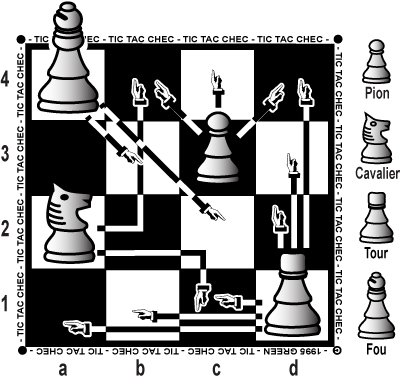
Déplacement des pièces:
LE PION - Le pion se déplace d'une case en avant, sauf pour capturer une pièce adverse. Le pion prend alors en avant et en diagonale.
LE CAVALIER - Le cavalier se déplace d'une case en avant comme une tour, puis d'une case en biais comme un fou en s'éloignant de sa case de départ. Il est la seule pièce capable de franchir une case occupée en sautant par-dessus.
LE FOU - Le fou se déplace en diagonale n'importe quel nombre de case. Il ne peut franchir une case occupée.
LA TOUR - La tour se déplace verticalement ou horizontalement.
Elle ne peut franchir une case occupée.
TIPS:
1/ Emphasize the goal of getting all four pieces in a row and avoid capturing unless there is a definite advantage gained so that players develop better strategy skills.
2/ Before making a move consider what your opponent is planning.
3/ Always play to win.
4/ Play a flexible strategy by frequently changing where you are making your row. Fixating on a single row will most likely lead to a stalemate at best and more likely a loss.
5/ Avoid trying to make a row of pieces on your first horizontal row of squares. This will most likely lead to defeat as it is difficult to move the pawn back to this row if it is already on the board.
6/ Use a felt tip marker to mark one side of the pawn and always play with this mark facing the direction of movement. This will help you remember its direction.
7/ As in regular Chess, dominating the center of the board helps as some pieces have more potential places to move to.
Conseils:
1/ Aligner quatre pièces en position verticale, horizontale ou en diagonale en évitant d’en perdre une, sauf si cela représente un avantage stratégique.
2/ Anticiper les mouvements de l’adversaire.
3/ Toujours jouer pour gagner.
4/Changer fréquemment la position de votre ligne afin d’empêcher votre adversaire de deviner votre stratégie.
5/Eviter d’aligner quatre pièces sur la première ligne. Cela vous mènerait à la défaite car il est difficile de bouger un Pion qui se trouve sur cette rangée.
6/Faire une marque au crayon sur le Pion à l’orienter en fonction du mouvement de cette pièce afin de se souvenir de la direction prise.
7/Tout comme pour les échecs, dominer le centre de l’échiquier donne plus de possibilités quant aux mouvements des pièces.
We designed Tic Tac Chec to help introduce the basic moves and play of chess, a wonderful game that provides a life time of benefits. There are 4 important reasons for learning chess with Tic Tac Chec:
Four important reasons for learning chess with Tic Tac Chec:
1/ There are only one-fourth as many pieces, so it is less confusing for a beginner.
2/ Captured pieces are returned and can be played again on ANY open square thus preventing new players from getting discouraged.
3/ Games only last a few minutes. There is no time spent setting up the board. Beginners don't use time "trading" pieces until there are only a few left at which time they are able to contemplate a strategy to defend their own King and capture the opponent's.
4/ Immediate recognition of mistakes. On a regular chess board beginners seldom remember where they made strategic errors and thus take longer to learn to avoid repeating them. A basic error while playing Tic Tac Chec almost always leads to instantly losing the game.
Tic Tac Chec a été conçu pour initier aux mouvements de base des échecs, jeu merveilleux. Voici, les 4 raisons principales d’apprendre à jouer à Tic Tac Chec:
Quatre raisons importantes d’apprendre à jouer à Tic Tac Chec :
- Il y a 4 fois moins de pièces ce qui est plus simple pour les débutants.
- Les pièces prises sont redonnées, ce qui permet de rejouer sur n’importe quelle case libre et évite aux joueurs de se décourager.
- Une partie ne dure que quelques minutes. Les pièces sont disposées rapidement sur l’échiquier. Les débutants ne perdent pas de temps à préserver leurs pièces afin de protéger leur Roi.
- Un joueur repère immédiatement ses faux pas. Aux échecs traditionnels, il se souvient rarement de ses erreurs de tactique et met plus de temps à ne pas les répéter. Lorsqu’un joueur commet une erreur, il perd instantanément.
Recording piece moves:
As on a standard chess board each square is identified by a reference co-ordinate for example in the illustration above the Knight or horse is located on a2. The vertical rows of squares or FILES are named first using lowercase letters followed by the horizontal rows of squares called RANKS. Piece moves are recorded by the position they are moved to and with a capital letter to represent the piece. Knight (N), Bishop (B), Rook (R), King (K), Queen (Q). In regular chess a Pawn has no abreviation but in Tic Tac Chec it can help to use (P). Since we do not start a game with any pieces on the board, the recording of a piece placed on any unoccupied square on the board is prefixed with an "O" for opening position. In regular chess it is possible to have 2 of the same pieces able to be moved to the same square, in which case the original and final position of the piece is recorded. For example Naxb4 where the Knight in file a is moved to file b and rank four. More information is available on the internet or in beginner chess books.
Enregistrer le mouvement des pièces:
Comme sur un échiquier standard, chaque case est identifiée par des coordonnées. Par exemple, dans l’illustration ci-dessus, le cavalier est situé sur a 2. Les cases rangées verticalement se nomment « colonnes ». Elles sont identifiées par une lettre, suivie d’un chiffre qui désigne les cases horizontales que l’on nomme « rangées ».
Les mouvements des pièces sont enregistrés par les coordonnées de leur position après chaque déplacement. Une lettre capitale désignant chaque pièce, suit les coordonnées. (N) pour le cavalier, (B) pour le fou, (R) pour la tour, (K) pour le roi, (Q) pour la reine. Dans le jeu d’échecs, le pion n’a pas de lettre, mais au Tic tac Chec on peut utiliser (P).
Comme on commence le jeu sans aucune pièce sur l’échiquier, on notera une pièce placée sur une case inoccupée par un (O), pour position d’Ouverture. Dans le jeu d’échecs normal il est possible que deux pièces puissent viser la même case. Dans ce cas, la position de départ et d’arrivée sont notées. Par exemple N a x b 4 si le cavalier de la colonne a est déplacé vers la colonne b à la rangée 4.
Vous trouverez des informations supplémentaires sur internet ou sur un livre d’initiation aux échecs.
Ⓒ1995 Donald Green with United States Copyright Office - Library of Congress USA # TX 4-327-443
TIC TAC CHEC
Translated the 23 Feb. 2008 by my good friend Mathias Ruge of Denmark. Many thanks - Don
The fastest, easiest way to learn Chess and the most popular chess variant in the world. – A gift for life
Den hurtigste, letteste måde at lære skak på samt den mest populære variation af skak på verdensplan. – En gave for livet
A winner of multiple awards and accolades.
En vinder af flere priser og anerkendelser
Millions of people have mastered the basic elements of chess within minutes playing Tic Tac Chec including moves and simple strategy without being intimidated. This quick, fun game combines aspects of both chess and tic tac toe.
Millioner af mennesker har lært basiselementerne i skak, inklusiv træk og simple strategier uden at blive frustrerede ved at spille Tic Tac Chec i få minutter. Dette hurtige og sjove spil kombinerer både dele fra skak og 4 på stribe.
RULES:
Be the first to align your four pieces of the same color horizontally, vertically or diagonally.
Play starts on an empty board, players take turns placing a piece on ANY empty square. (anywhere on the board) After placing your first three pieces you may move and capture as in regular chess, except a pawn reverses direction upon reaching the opposite side of the board. Captured pieces are returned to their owner and can immediately be played again on any open square. You can place a pawn on the opposite side of the board and immediately on the next turn move back towards yourself. If it is captured then placed back on the board it must first move towards the opponent's side of the board before changing directions.
REGLER:
Vinderen er den som først får samlet alle sine fire brikker på en lige linje; vandret, lodret eller diagonalt.
Spillet starter altid med en tom spilleplade. På skift placerer spillerne en brik på et frit felt, hvor som helst på spillepladen. Når du har placeret dine første 3 brikker må du rykke og slå modstandernes brikker fuldstændig som i almindelig skak. Dog med den undtagelse at bønder skifter retning når de kommer til den anden side af spillepladen. Er en brik slået ud af spil, skal den afleveres tilbage til ejeren som derefter kan bringe brikken i spil på et frit felt. Man kan placere en bonde på modsatte side af spillepladen, og rykke den mod sig selv næste gang det bliver ens tur. Hvis den bliver slået og derefter bragt i spil, skal den først rykkes imod modstanderen før den kan ændre retning og rykke tilbage mod en selv.
Optional Rules: Recommended for competitions. Players are allowed approximately 3 minutes to place their first 3 pieces on the board with a maximum of about 30 seconds per turn. After a further 5 minutes of play (this can be adjusted) and an equal number of turns each player is
restricted to 5 captures each. Playing this rule will generally make games end in less than 15 minutes and require more skill.
Valgfrie regler: Anbefalet for konkurrencer. Spillerne må maks. bruge 3 minutter på at placere deres 3 første brikker på spillepladen, med maks. 30 sekunder per brik. Efter 5 minutters spil (eksempel) og et lige antal runder, må man maks. slå modstanderens brikker 5 gange. Hvis man spiller med denne regel, vil spillet ikke tage længere end 15 minutter samt kræve en del bedre færdigheder.
Chess Piece Moves:
Pawn: - Moves one space forward per turn except when it captures an opponent piece by moving one space diagonally forward.
Knight: - Moves either one space forward or backward and two spaces either left or right or two spaces forward or backward and one space either left or right. A knight is the only piece that can move over another piece on the board.
Bishop: - Moves diagonally any number of spaces as long as it does not pass another piece.
Rook: - Moves vertically or horizontally as long as it does not pass another piece.
The Knight, Bishop and Rook all capture by landing on an opponent's piece in the same way that they move.
Skakbrikkerne og deres bevægelser:
Bonde: - Rykker et felt fremad per tur, undtagen når den slår en modstanders brik, ved at rykke diagonalt et felt fremad.
Springer: - Rykker enten et felt frem eller tilbage og to felter til højre eller venstre. - eller to felter frem eller tibage og et felt til højre eller venstre.
Løber: - Rykker til ethvert felt på de diagonaler den står på, så længe den ikke rammer andre brikker.
Tårn: - Rykker vandret og lodret på den række eller linje den selv står på, så længe den ikke rammer andre brikker.
Springeren, løberen og tårnet slår alle brikker ved at lande på et felt hvor din modstander allerede har en brik stående.
Tips:
1/ Emphasize the goal of getting all four pieces in a row and avoid capturing unless there is a definite advantage gained so that players develop better strategy skills.
2/ Before making a move consider what your opponent is planning.
3/ Always play to win.
4/ Play a flexible strategy by frequently changing where you are making your row. Fixating on a single row will most likely lead to a stalemate at best and more likely a loss.
5/ Avoid trying to make a row of pieces on your first horizontal row of squares. This will most likely lead to defeat as it is difficult to move the pawn back to this row if it is already on the board.
6/ Use a felt tip marker to mark one side of the pawn and always play with this mark facing the direction of movement. This will help you remember its direction.
7/ As in regular Chess, dominating the center of the board helps as some pieces have more potential places to move to.
Tips:
1/ Foretræk altid at få dine egne fire brikker på stribe, frem for at slå modstandernes. Slå kun modstanderens brik, for at undgå at han får fire på stribe.
2/ Overvej altid din modstanders muligheder, før du selv foretager et træk.
3/ Spil altid for at vinde.
4/ Spil med en fleksibel strategi, hvor du har mindst to muligheder for at vinde.
5/ Prøv ikke at lave 4 på stribe på de første 4 felter mod dig selv. Det er en hyppig årsag til nederlag, da bonden har svært ved at komme tilbage til den samme stribe, hvis den allerede er på spillepladen.
6/ Sæt en prik på den ene side af bonden og bevæg den altid den vej. Så ved du altid hvilken vej den bevæger sig.
7/ Ligesom i almindelig skak er det en god idé at kontrollere midten, da det giver de bedste muligheder for at kontrollere hele pladen.
4 Reasons for using TTC to learn chess. We designed Tic Tac Chec to help introduce the basic moves and play of chess, a wonderful game that provides a life time of benefits.
1/ There are only one fourth as many pieces, so it is less confusing for a beginner. Even though each player only receives 4 pieces, every piece on a regular chess board is accommodated. We don't have a queen, but then a queen moves the same as a Bishop and a Rook. A King only moves one space in any direction so this piece is really unnecessary for learning the basics.
2/ If a players' pieces are captured, they are returned to them and they may replace them on the board on any open square when it suits them. This is much less intimidating for a novice player. If your piece is captured it could even be to your advantage.
3/ There is no time spent setting up the board. Beginners don't use time "trading" pieces until there are only a few left at which time they are able to contemplate a strategy to defend their own King and cature the opponent's. Since games are so much quicker and often lost by simple errors, players will want to get revenge and immediately play again. This and the mental challenge have made the game of Tic Tac Chec a game with high repeat play value.
4/ Immediate recognition of mistakes. On a regular chess board beginners seldom remember where they made strategic errors and thus take longer to learn to avoid rpeating them. A basic error while playing Tic Tac Chec almost always leads to instantly losing the game.
Fire gode grunde til at lære skak med Tic Tac Chec:
1/ For en nybegynder er spillet lettere at overskue når der kun bruges en fjerdedel af brikkerne.
2/ En slået brik kan bringes i spil på et hvilket som helst frit felt, hvilket sikrer at nybegynderen ikke taber modet.
3/ Spillene tager kun et øjeblik, og man spilder ikke tiden på at stille brikkerne op. Spillet er i gang fra første træk, så tiden går ikke med at spille brikkerne i position først.
4/ Man indser fejlene i samme øjeblik man foretager et forkert træk. I normal skak opdager en nybegynder sjældent, hvor man begik en strategisk fejl. Derved går der længere tid før man lærer at undgå dem. Foretager man en fejl i Tic Tac Chec fører det nærmest uundgåeligt til et hurtigt nederlag.